Winegrowing in Japan began with the adaption of Western culture during the Meiji restoration in the second half of the 19th century in Yamanashi. Although, the Koshu variety had been grown there for over 1200 years.
There is a wide variety of grapes grown in Japan that can be grouped under the following categories.
Indigenous & Eastern Asian grapes ; Vitis coignetiae (ex. Yamabudou ).Wild, highly acidic, deep color
European grapes; Vitis vinifera (ex. Merlot Chardonnay Koshu Zenkoji).Increasingly successful in higher altitude
North American grapes; Vitis labrusca (ex. Niagara Portland Delaware-Vitis vinifera)Historically dominated, highly disease-resistant
Japan-Specific Crossbreeds; (Muscat-Bailey A Black queen Yamasachi)Created specifically to withstand Japan’s hot summer, humidity and rainfall
Surface :
16300 ha (Total grape cultivation area), 2000-2500 ha (wine grape cultivation area)
Production:
815,790 hl (Domestic Wine production)
143,240 hl (Japanese Wine production:100% domestic grown grapes and produced within Japan)
Consumption :
2,8 Mhl
Soils : all types.
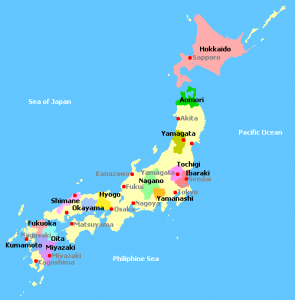
Climate : all types. Heavy winter snowfalls and relatively cool summer in the northern island Hokkaido(41.1 degrees north latitude). Hot humid, heavy rainfall in summer in the southern islands of Okinawa(26.3 degreesnorth latitude).
Main white grape varieties : Koshu(certified by the O.I.V. ) Niagara, Delaware, Chardonnay, Kerner, Sauvignon blanc, Portland, Muller-Thurgau, Seibel, Zenkoji(O.I.V. )
Main red grape varieties : Muscat-Bailey A (O.I.V. ) Merlot, Concord, Campbell early, Blackqueen, CabernetSauvignon, Zweigeltrebe, Yamasachi (O.I.V. )
Vineyards are spread all over Japan from Hokkaido in the north to Okinawa islands in south.
46 prefectures of Japan have winery. Only one prefecture Saga does not have winery.
Now Saga is cultivating wine grapes. Wine from Saga will come soon.
Hokkaido: Kamikawa region, Sorachi region, Shiribeshi region, Tokachi region
Iwate prefecture: Kitakami basin
Yamagata prefecture: Shonai plain, Yamagata basin, Nanyo city, Nonezawa city
Niigata prefecture: Niigata plain
Nagano prefecture: Nagano basin Matsumoto basin, Ina basin
Yamanashi prefecture: Koshu basin
In 2015, government defined “Japanese Wine(Nihon Wine)” which is produced in Japan from Japanese grown grapes.
Also, government designated the Geographical Indication(G.I.) for alcoholic beverages (Sake, Shochu, Wine other). From 2013 following areas were designated as G.I. for Japanese Wine.
G.I. Yamanashi : from 2013 42,780 hl (29.9% share) The birthplace of Japan Wine
Koshu, Muscat Bailey A and 40 cepage
G.I. Hokkaido : from 2018 36.380 hl (25.4% share) The cool-climate frontier
Niagara, Campbell early, Kerner, Muller-Thrugau, Zweigeltrebe. Pinot Noir, Yamasachi and 49 cepage
G.I. Nagano : from 2021 27,670 hl (19.3% share) Quality born of altitude. Merlot, Chardonnay, Cabernet Sauvignon, Niagara, Zenkoji and 45 cepage
G.I. Yamagata : from 2021 9,970 hl (7.0% share) Coexisting with snow. Muscat Bailey A, Merlot, Yama-Sauvignon, Delaware, Chardonnay, Niagara and 30 cepage
G.I. Osaka : from 2021 390 hl (0.3% share) Old historic area of Japan Wine. Delaware, Muscat Bailey A, Merlot Campbell early, Chardonnay and 32 cepage